
RKMM Archives and References—
The Twin Digital Platforms of Ramakrishna Order for Historical Preservation and Dissemination of Swami Vivekananda’s Message to the World
Introduction
The first Governor General of India C Rajagopalachari (Rajaji) writes: ‘Swami Vivekananda saved Hinduism and saved India. But for him we would have lost our religion and would not have gained our freedom. We therefore owe everything to Swami Vivekananda. May his faith, his courage, and his wisdom ever inspire us so that we may keep safe the treasures we have received from him!’1 A renowned Indian historian R C Majumdar also captures Swamiji’s keen interest in historical research through modern advancements: ‘He was also familiar with the scientific and critical method of historical research and modern developments in Archaeology and Ethnology.’2
Based upon the above-mentioned details, it’s vital that archival materials related to Swami Vivekananda and Ramakrishna Order continue to be preserved and his teachings are disseminated through modern methodologies.
At this juncture of the 125th-anniversary celebrations of the founding of the Ramakrishna Mission, a twin digital platform called RKMM (Ramakrishna Math and Mission) Archives and References has been planned—the objective of the archives platform is to digitally preserve and organise the archival material pertaining to Ramakrishna Order, while the goal for references platform is to disseminate effectively the knowledge sourced from the digitised archival content to the public. The archives platform would contain curated high-quality digital archival content and one would then selectively choose, organise, and adapt the content into presentable formats on the references platform that would benefit researchers, spiritual aspirants, devotees, and enthusiasts of Indian spiritual knowledge across the world.
Digital Archives and Archivists
Archives are defined as documentation of human activity created by individuals and organisations that provide insight into past events and they come in written, photographic, moving image, sound, digital, and analogue formats typically retained for their long-term value.3 Archivists are the record keepers of an organisation’s activity that includes collecting, managing, and providing access to archives for the long term.4 In short, archives store the ‘memories’ of an organisation while archivists are the ‘guardians’ of the organisation’s memories.
Archives are now undergoing a transition from the analogue world to the digital universe. According to the Office of the State Archivist in Australia: ‘A digital archive encompasses the technical infrastructure, standards, policies and procedures, and support services for managing and providing access to digital objects and their associated data descriptors.’5 Digital Archival tools are developed to collect, catalogue, preserve, and disseminate archival information. Digital archiving is not merely a mechanism for data storage, but also provides an intelligent way to utilise the archival content while maintaining its integrity and authenticity.
Digitisation of Archives—2D and 3D scanning
Digitisation is a simple transformation from an analogue source to a digital resource. The majority of the digitisation of archival materials at Ramakrishna Math is in 2D format and these are done with document scanners and still/motion picture cameras. But there are some old statues in Ramakrishna Math sculpted many years back that are of greater artistic and spiritual value. Recreating them would be a bigger challenge as the artists who may have originally sculpted them may no longer be alive. As time progresses, these statues are subject to minor deteriorations which our naked eye would not be able to notice even though many physical preservation measures for the statue would have been taken. Also, if the statue was ever damaged or needed repairs in the future, there needs to be a matching digital reference to the original.
To accommodate this requirement, 3D Digitisation could be deployed to scan statues volumetrically and through photogrammetry tools, a blueprint can be developed for their preservation as well as restoration. The reason a 3D scan would be better is that the 2D photos or drawings cannot match the accuracy of a 3D scan. Besides statues and artifacts, even monuments and landscapes could be digitally scanned using a combination of laser scanners, drones, and photogrammetry tools.6, 7 For instance, if a landscape such as Belur Math campus including the temples when digitally scanned in 3D, could portray an accurate visualisation of the evolution of changes over a timeline.
Metadata Creation and Management for Digital Archives
Digitisation of archival material doesn’t mean easy online access to the archival data. In the online era, with data overload, if data is invisible to search platforms, it is equivalent to lost data. Digitisation along with data description of archival content can drastically improve user access. This description of digital data is called Metadata or in simplified words called ‘data about data’. According to ISO 15489-1:2016, metadata is data that describes the context, content, and structure of records and their management through time.8 Metadata not only identifies and describes the digital object but also can answer what, why, how, when, who, and how every facet of data is stored and preserved.9 Metadata could both be machine and human-generated descriptions of a digitised object.
The functions of metadata are as follows:
- a) Creation and Versioning
- b) Organisation and Description
- c) Search and Retrieval, and
- d) Utilisation and Preservation
When a digital object is created, there will be multiple versions of the same object optimised for a specific purpose—preservation or dissemination. The meta-information about the digital object is then prepared and organized manually or automatically into the structure of the digital archival system. The better the meta-information about the digital object, the better will be the search and retrieval purposes both from a user and admin perspective. The digital object could go through multiple transformations where the lifecycle needs to be captured and added to the existing metadata. The metadata also helps with the authenticity and integrity of a digital object.10
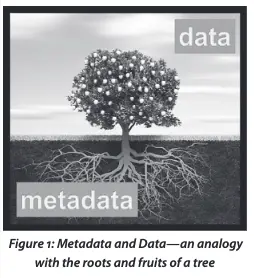
Figure 1: Metadata and Data—an analogy with the roots and fruits of a tree
Preservation of Digital Archives
Digitisation doesn’t necessarily mean that the archival content is safe and preserved for a lifetime. Organisations invested in digital conversion need to deal with the fact that digital content could be rendered useless due to rapid technological changes called ‘technological obsolescence’. A digital preservation solution is required that will ensure continued access and usability of digital resources. To ensure the preservation of a digitised object, digital preservation policies and methods have to be defined and implemented.11 Migration from the older digital formats to the new digital formats seems to be the most widely adopted preservation strategy, especially for organisations with large-scale archives.12 For example, when the popular desktop publishing software Adobe Pagemaker was discontinued and replaced with Adobe InDesign, the publication centres of Ramakrishna Math and Mission had to migrate the publications designed using Pagemaker into Indesign format. The fonts also had to be transitioned from non-Unicode fonts to Unicode fonts so that the digital publications can be published online.
Need for a Digital Archival Management Platform
Although the digitisation process has begun early in a decentralised manner across Ramakrishna Math and Mission branch centres (especially in the book/magazine publishing centres), non-standardised digitisation workflow along with limited expertise in the archival process has resulted in a variation in the digital quality levels of the archival content. The digital archives were usually kept locally by a centre utilising either disk storage or cloud storage and then typically shared with book authors, magazine editors, researchers, and webmasters within the organisation upon request. This has led to the duplication of digital collections with multiple versions created within the organisation.
This further results in the degradation of media quality due to processing and conversion into multiple formats optimised either for printing in books/magazines or publishing online. In addition to this, there has been data loss of digital archives that occurs either due to disk corruption on local storage or forgetting the credentials to access the cloud storage. Hence, a robust collaborative online digital archival management platform is required where archivists would curate, upload, and catalogue the archival content at the highest quality.
RKMM Archives—Building the Next-Generation Digital Archival Management Platform
The objective of RKMM Archives is to build a collaborative online digital archival management platform where archivists would curate, upload, and catalogue the digital archival content at the highest quality with appropriate meta descriptions. The content would contain high-quality digital versions of books, magazines, documents, reports, photos, audio, video, artwork, manuscripts, newspaper clippings, letters, bulletins, event invitations, pamphlets, maps, artifacts, statues, and landscapes pertaining to Ramakrishna Order.
The design process begins with detailed research and review of existing modern digital archival systems to identify the building blocks of the new digital archival management platform. The core software components would utilise PaaS (Platform as a Service) model while the storage component will make use of the STaaS (Storage as a Service) model so that there is minimal maintainability due to automatic software updates. The following feature set is planned for the RKMM Archives platform in comparison with the modern archival systems available online:13
- a) Modern UX Interface—Build a responsive user interface with a display adapting to multiple screen sizes including mobile devices.
- b) Content Types—Support document types (Example: Books, Magazines, Letters) and media types (Example: Photos, Audio, Video).
- c) Content Import—Supports bulk upload so that digital archives can be loaded on the cloud rapidly.
- d) Content Organisation—Enable individual units and collections of archival data.
- e) Descriptive Metadata—Supports popular metadata standards such as Dublin Core.14
- f) Advanced Cloud Search—Supports fast and live search.
- g) Access Controls—Enable visibility levels such as ‘Open Access’, ‘Organisation Access’, and ‘Private’.
- h) Role Management—Enables group access such as ‘Administrator’, ‘Manager’, and ‘User’.
- i) File Management—Supports versioning and be able to retrieve previous versions of archival data.
Figure 2: Digital Archival content types
The digital archival platform would also additionally include a BooksDB (Books Database) that will include the digital versions of all the books (with multiple editions and metadata included) published by Ramakrishna Math and Mission since its inception. While we may be late in building such an archival system, the advantage is that we could utilise the latest technologies to make the platform more advanced and robust compared to the existing archival platforms available online.
Need for a Digital References platform
With the advent of high-speed wireless connectivity and smartphones, there has been an increase in digital literacy resulting in a greater appetite for the message of Swami Vivekananda, especially among youth. At the same time, on the flip side, there has also been an increase in misinformation on social media on the life and teachings of Swamiji. To counteract this, a digital platform has been proposed that would contain the core reference books (Example: Complete Works of Swami Vivekananda), magazines, and quotes derived from the publications of Ramakrishna Order in all major languages. The references platform provides an option to search and retrieve accurate information and enables easy sharing across social media to debunk the false information being circulated online.
RKMM References—Building the Next generation References Platform
RKMM references is a one-stop browsable and searchable unified knowledge platform containing essential books, magazine archives, quotes, history and chronology, bhajans and chanting lyrics pertaining to Ramakrishna Order for the public. The platform will utilise SaaS (Software as a Service) model so that there is minimal maintainability due to automatic software updates.
As part of the references platform, the following two knowledge repositories have been added: (a) AWAKE Questions/Answers, and (b) AWAKE Fact Checker.
AWAKE (Awakening of Knowledge and Wisdom through Enquiries and Answers) is a one-stop searchable digital media repository of spiritual and scriptural knowledge derived from the publications of Ramakrishna Order in a Question-Answer format. In AWAKE, the Questions are classified based on the topic (Example: Vedanta, Yoga, Meditation) and the seeker of the question (Example: Balaka, Nava Yuvaka, Sadhaka, Grihashta, Mahila).
AWAKE Fact Checker is to educate the public with factual information about Swami Vivekananda and Ramakrishna Math and Mission derived from the original publication sources and dispel the misinformation circulating on social media.
Questions
&
Answers
Fact
Checker
Knowledge and
Wisdom through
Enquiries and
Answers
Figure 3: AWAKE Questions/Answers and Fact Checker repository
For example, the following question is a popular one in Fact Check—A voice recording of Swami Vivekananda addressing ‘Sisters and Brothers of America’ is popular on social media. Does such a voice recording really exist?
A fact-based explanation tagged with ‘Fact’ is displayed first followed by the list of ‘Fake’ information. This helps the public to distinguish factual information from fake ones.
For the RKMM References platform and AWAKE repository, the following feature set is planned:
- a) Simple and Clean Interface—Build a simple and clean interface with better formatting optimised for online reading on all devices.
- b) Improved Cloud Search—Faster search within a book or topic and extended cloud search across multiple books or topics.
- c) Multi-lingual support—Support for all major Indian languages using Unicode fonts.
- d) Metadata Tagging—Filter by topic, author, and other essential metadata.
Interface
References
Platform
Figure 4: RKMM References Platform feature set
The current functionalities that RKMM References (and Archives) platform would provide are just a starter but with more advanced technologies such as Big Data, Blockchain, Data Analytics, Deep Learning, NLP Chatbots, Voice Services, and Mixed Reality, the future possibilities are endless.
Conclusion
The objective of the digital preservation of archives in a spiritual organisation is not just to merely capture the historical data as a record but rather to provide context to the archival content to get a meaningful interpretation.15 For instance, when Swamiji spoke or wrote, it would be always to a particular person or group on a particular occasion or situation. Recording the date, place, person, and situation helps understand deeply the context in which Swamiji spoke or wrote. Sometimes, what Swamiji said may be less significant than how and why he said it.16
For an organisation like Ramakrishna Math and Mission destined to spread Swami Vivekananda’s message for many years to come, the archival content is of greater importance since his teachings have to be interpreted in the right context so as to be a guiding force for the future generation of the world.
The RKMM References platform and a unified publications website for Ramakrishna Math and Mission has been launched on 21 October 2022 at Belur Math Heads Conference by Srimat Swami Gautamanandaji Maharaj, Vice-President of Ramakrishna Math and Mission, and Swami Suvirananda, General Secretary of Ramakrishna Math and Mission respectively. The references platform, awake repository, and website can be accessed by visiting the link: https://publications.rkmm.org.
References
- Great thinkers on Ramakrishna-Vivekananda (Kolkata: Ramakrishna Mission Institute of Culture, 2009), 86.
- Ibid., 120–25.
- What are archives? (2022); Available from: https://www.ica.org/en/what-archive.
- Who is an archivist? (2022); Available from: https://www.ica.org/en/discover-archives-and-our-profession.
- Glossary—Publications of Office of the State Archivist (2022); Available from: https://www.informationstrategy.tas.gov.au/Publications/Pages/Glossary.aspx.
- C Lauter, Before the bombs fall: The race to digitise Ukranian cultural heritage sites (2022); Available from: https://www.geoweeknews.com/news/before-the-bombs-fall-the-race-to-preserve-ukranian-cultural-heritage.
- M Collins, Scientists Create 3D Digital Archive of Former Gold Rush Town (2022); Available from: https://www.geoweeknews.com/news/scientists-create-3d-digital-archive-of-former-gold-rush-town.
- ISO, ISO 15489-1:2016. 2016, International Organisation for Standardisation.
- B K Choudhary, Metadata and Dublin Core (LIB). LIB:P-03 Knowledge organisation and processing (2015); Available from: https://youtu.be/bM98FTSc8f4.
- M Baca, Introduction to Metadata (Los Angeles: Getty Research Institute, 2016), vii.
- ‘3—Digitisation’, Archives in the Digital Age, ed. L Bountouri (Chandos Publishing, 2017), 29–36.
- ‘4—Digital preservation’, Archives in the Digital Age, ed. L Bountouri (Chandos Publishing, 2017), 37–50.
- H Frost, Hyku Features (Hyku Documentation, 2021); Available from: https://samvera.atlassian.net/wiki/spaces/hyku/pages/718083410/Hyku+Features.
- Dublin Core Specifications (2022); Available from: https://www.dublincore.org/specifications/dublin-core/.
- A Mkadmi, Archives in the Digital Age: Preservation and the Right to be Forgotten (Wiley, 2021).
- N Hạnh, Living Buddha, Living Christ (Riverhead Books, 1997).